Who is Responsible for Employee Health Information?

Summary:

Organizations are responsible for protecting their employees’ personal information. This is regulated under different laws, and by different state and federal agencies. Depending on the kinds of health benefits provided to employees, there are some different regulatory items HR needs to be aware of.  HIPAA applies to employers when the organization has a self-funded or […]

Organizations are responsible for protecting their employees’ personal information. This is regulated under different laws, and by different state and federal agencies. Depending on the kinds of health benefits provided to employees, there are some different regulatory items HR needs to be aware of. 

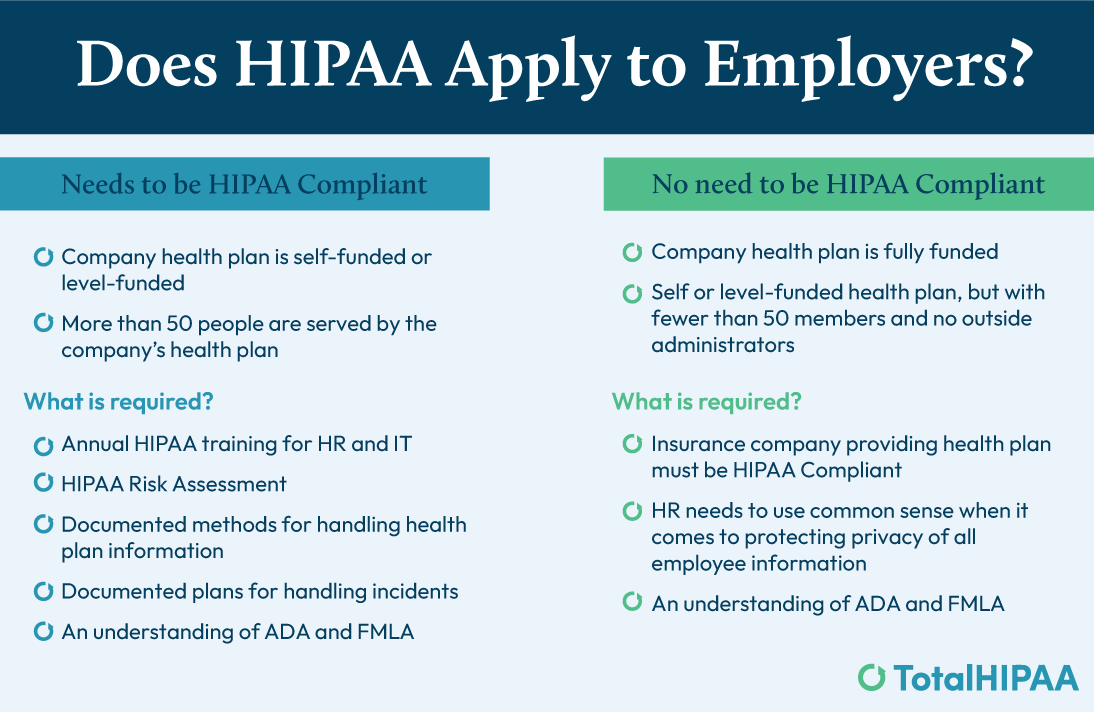
HIPAA applies to employers when the organization has a self-funded or level-funded health plan. In all other cases health information confidentiality falls under the purview of Americans with Disabilities Act (ADA) and/or Family Medical Leave Act regulations.

In most cases, the responsibility for safeguarding health information confidentiality lies within the jurisdiction of the Americans with Disabilities Act (ADA) and the Family and Medical Leave Act (FMLA) regulations. These two laws play pivotal roles in ensuring that employees’ health-related data is handled with care and respect for their privacy. While HIPAA might not directly apply to most employers, understanding the implications of ADA and FMLA is crucial for maintaining a secure and respectful environment for employees, particularly when addressing absences or FMLA-related health matters.

Now, when does HIPAA become relevant for employers? HIPAA comes into play when an employer chooses to self-insure or go with a level-funded plan, which means they assume the financial risk of providing health benefits to their employees. In this scenario, HIPAA regulations become applicable, and the employer is designated as a Covered Entity, bound by strict privacy and security standards in the handling of employees’ protected health information (PHI) which the HR staff will be seeing as part of their work handling the health plan.
Key Takeaway:

For the vast majority of employers who rely on external insurance providers, it’s not the employer but rather the insurance companies that are the Covered Entities. These insurers must adhere to HIPAA rules when managing health information for the company they provide health insurance to.

If you have determined your company needs to be HIPAA compliant please book a demo to learn about HIPAA Prime. Total HIPAA specializes in making HIPAA compliance an easy and comprehensive way to become cyber secure. We look forward to meeting you!
Book a Clarity Call Today.

Further Reading for Employers:
HIPAA and ERISA: Everything You Need To Know

Sharing is caring!

Looking for a Business Associate Agreement?

Download our free template to get started on your path toward HIPAA compliance.

Download Now

Want to stay informed?

Join our community, stay ahead of the curve on HIPAA compliance and receive free expert guidance.

Related Posts

HHS’ Office for Civil Rights Settles Ransomware Investigation with Health Plan

HHS’ Office for Civil Rights Settles Ransomware Investigation with Health Plan

The U.S. Department of Health and Human Services (HHS) Office for Civil Rights (OCR) announced a $450,000 settlement with Spencer Gifts LLC Flexible Benefits and Welfare Benefit Plans. Triggered by a 2021 ransomware attack that compromised the electronic Protected Health Information (ePHI) of over 10,000 individuals, the investigation revealed systemic failures to conduct accurate risk analyses and implement proper policies and procedures. This case serves as a massive wake-up call. HIPAA compliance extends far beyond traditional healthcare settings; it applies to any organization managing employer-sponsored group health plans, including self-funded and self-insured arrangements.

Why do we need to test our Disaster Recovery Plan every year?

Why do we need to test our Disaster Recovery Plan every year?

Even if your internal software and servers remain perfectly static, the infrastructure, vendor updates, and cyber threats around them are constantly shifting. Waiting 2 or 3 years to test your backup systems leaves you vulnerable. This post breaks down the four external factors that degrade an untested playbook, explores HIPAA compliance mandates under NIST SP 800-66, and provides a granular, step-by-step example of what a compliant disaster recovery blueprint actually looks like.

How to Maintain HIPAA Compliance in Public Cloud Environments

How to Maintain HIPAA Compliance in Public Cloud Environments

Storing ePHI in the public cloud offers scalability but requires a strict “Shared Responsibility” approach. To remain HIPAA compliant, organizations must go beyond basic Business Associate Agreements (BAAs). The implementation of AES-256 encryption, multi-factor authentication (MFA), and microsegmentation are now required. This guide outlines the essential steps to securing your cloud infrastructure while meeting the latest HHS and OCR standards.

Save & Share Cart
Your Shopping Cart will be saved and you'll be given a link. You, or anyone with the link, can use it to retrieve your Cart at any time.
Back Save & Share Cart
Your Shopping Cart will be saved with Product pictures and information, and Cart Totals. Then send it to yourself, or a friend, with a link to retrieve it at any time.
Your cart email sent successfully :)