
A HIPAA Risk Analysis or HIPAA Risk Assessment (these terms are often used interchangeably) is not just a regulatory hurdle; it’s the required foundation of your entire security program. Under the HIPAA Security Rule (45 CFR § 164.308(a)(1)(ii)(A)), every Covered Entity and Business Associate must conduct an accurate and thorough assessment of the potential risks and vulnerabilities to the confidentiality, integrity, and availability of all Electronic Protected Health Information (ePHI) they create, receive, maintain, or transmit.
Failing to conduct a proper and documented Risk Analysis is one of the top findings in HHS audits. The good news? While the HIPAA rule is flexible, the process follows a clear set of steps.
Your 6-Step HIPAA Risk Analysis Checklist
The Department of Health and Human Services (HHS) and NIST (National Institute of Standards and Technology) recommend a comprehensive, repeatable approach to your Risk Analysis. This process ensures you identify threats, prioritize risks, and manage your overall security posture.
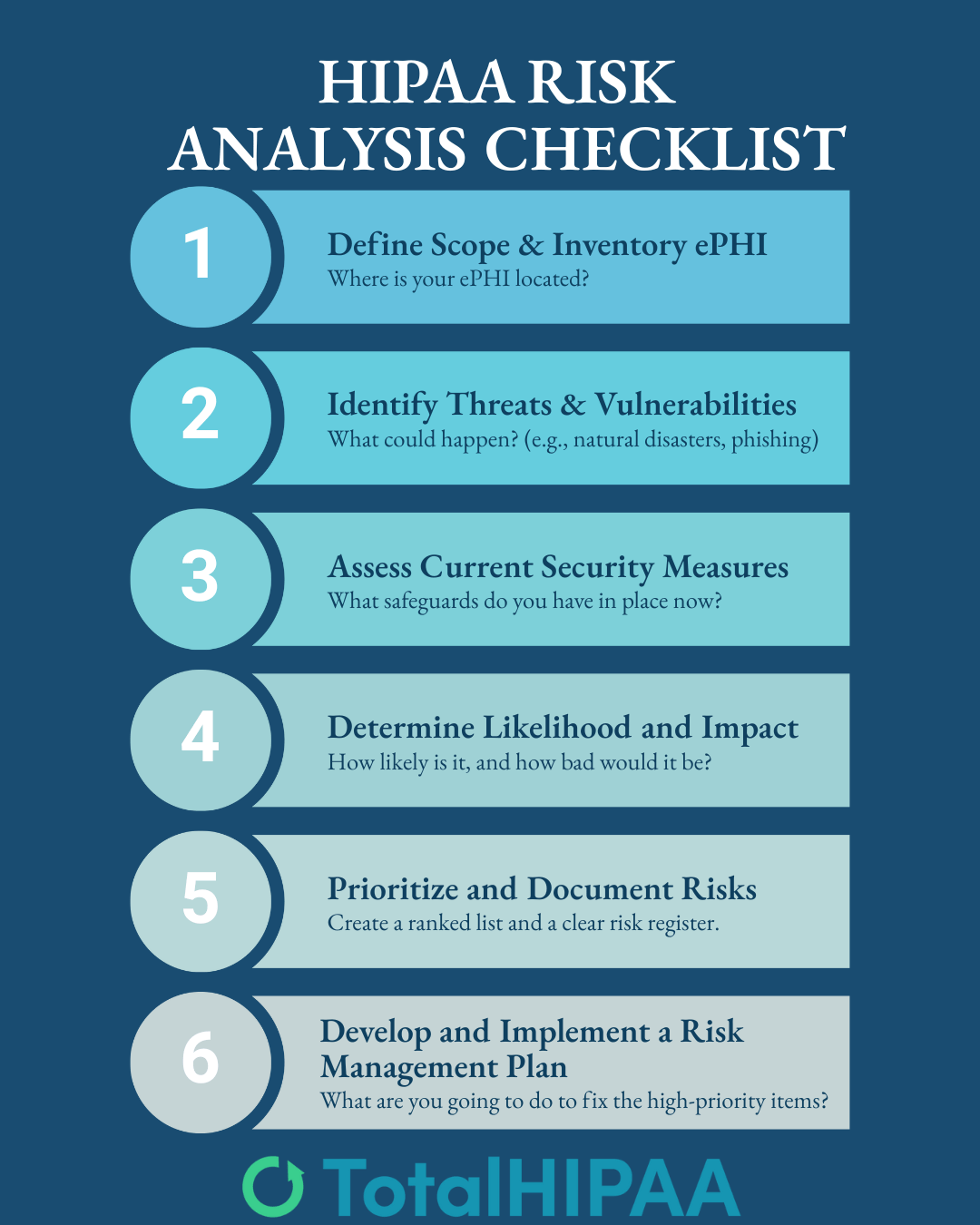
Step 1: Define Scope and Inventory PHI
Before you can protect your data, you must know where it lives. The scope of your Risk Analysis must include all systems and environments that create, receive, maintain, or transmit PHI.
- Record of all Paper PHI: This includes hard-copy records, faxes, printouts of emails, sign-in sheets, and any information received or sent via physical mail. You must document where these documents are stored (e.g., locked cabinets, secure off-site storage), who has access, and how they are ultimately destroyed.
- Inventory all locations: List every system, application, server, mobile device, and cloud service (like email and storage) that touches ePHI (this list may not be exhaustive).
- Document data flow: Create a map showing how ePHI enters, moves through, and leaves your organization. For example, ePHI might flow from a patient portal (reception) to an EHR (clinical staff) to a billing system (admin).
- Identify responsible parties: Note which staff members or departments are responsible for managing each system or data set.
Step 2: Identify Threats and Vulnerabilities
A Threat is a potential cause of an unwanted incident (e.g., a power outage). A Vulnerability is a weakness that a threat can exploit (e.g., a server room with no backup power).
- Identify Threat Sources:
- Human: Malicious insiders, human error (e.g., clicking a phishing link), unauthorized access.
- Natural/Environmental: Fire, flood, earthquake, prolonged power outage.
- System/Technical: Malware, ransomware, system failure, security misconfigurations.
- Identify System Vulnerabilities:
- Technical: Outdated operating systems, unpatched software, weak passwords, unencrypted data.
- Physical: Unlocked server rooms, visible monitors, lack of badge/secured access.
- Administrative: Lack of up-to-date policies, insufficient staff training, missing Business Associate Agreements (BAAs).
Step 3: Assess Current Security Measures
The HIPAA Security Rule is built upon three pillars: Administrative, Physical, and Technical Safeguards. This step requires you to review all of your existing policies and controls against the requirements of the Security Rule.
- Administrative Safeguards Check: Do you have written, implemented policies for security management, information access management, and workforce training? Total HIPAA provides comprehensive, customized policies and procedures, training, and risk assessment services.
- Physical Safeguards Check: Is your facility and equipment secured (e.g., locking computer/server rooms, controlling facility access)?
- Technical Safeguards Check: Are encryption, unique user identification, and audit controls in place for all ePHI systems?
Step 4: Determine Likelihood and Impact
This is the analytical part of the process, where you determine the level of risk associated with each identified threat/vulnerability pair.
- Assess Likelihood: For each threat/vulnerability, determine the probability of it occurring (e.g., High, Medium, Low). For example, the likelihood of a power outage is higher than a meteor strike.
- Assess Impact: If the event did occur, what would be the impact on the confidentiality, integrity, and availability of your ePHI?
- Confidentiality: Unauthorized disclosure of data.
- Integrity: Data being altered or destroyed.
- Availability: Users being unable to access necessary ePHI.
- Calculate Risk Level: The overall risk level is typically calculated as a function of Likelihood and Impact. Risk = Likelihood x Impact. A high likelihood combined with a high impact results in a Critical or High-Level Risk.
Step 5: Prioritize and Document Risks
You cannot fix every issue at once. The Risk Analysis process requires you to create a clear, prioritized record, your Risk Register, so you can focus your resources effectively.
- Create a Risk Register: Document every identified risk, including the threat, the vulnerability, the system affected, the current controls, and the calculated risk level.
- Prioritize Remediation: Rank your risks from highest to lowest severity. All Critical and High risks must be addressed first.
- Assign Ownership: Assign a specific staff member or team to be responsible for mitigating each risk.
Step 6: Develop and Implement a Risk Management Plan
A Risk Assessment is only the first step; Risk Management is the required continuous process steps needed to reduce the risks you’ve identified (45 CFR § 164.308(a)(1)(ii)(B)).
- Develop Mitigation Strategies: For each high-priority risk, define the specific steps needed to reduce the risk to an acceptable level.
- Example Risk: Unpatched firewall software (Vulnerability) + Ransomware attack (Threat) = High Risk.
- Mitigation: Implement a patch management policy, apply all critical firewall updates immediately, and schedule regular vulnerability scans.
- Implement the Plan: Put the identified technical, physical, and administrative safeguards in place.
- Review and Update: A Risk Assessment is not a one-time activity. HHS guidance suggests that you review and update your Risk Assessment at least annually or whenever there are significant changes to your environment, such as new technology, a security incident, or a major change in business operations (See the HHS Guidance on Risk Analysis for more detail).
Ready to Simplify Your Risk Analysis?
Completing an accurate, thorough, and well-documented Risk Assessment requires expertise and attention to detail.
For many organizations, the complexity of the Security Rule can feel overwhelming. Total HIPAA simplifies this process with a dynamic platform and expert support that streamlines your annual Risk Assessment, policy creation, and training requirements – giving you the peace of mind that comes with proven compliance.
Are you ready to stop managing compliance and start focusing on your organization?

